The Banstead Image Library
BRIGHTON ROAD, BANSTEAD, 


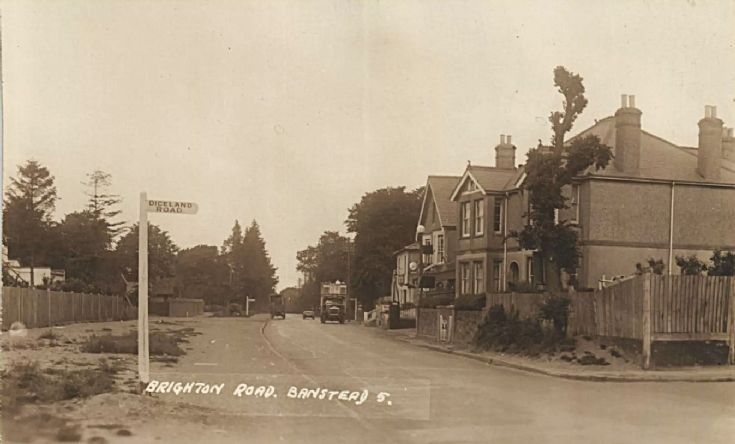
BRIGHTON ROAD, BANSTEAD, c1915
Undated view looking north captured opposite Diceland Road.
Almost visible on the left is the ornamental gatehouse into Nork Park - one of several entrances around their boundary. Today this is The Drive.
Opposite the gatehouse lies Garratts Lane, leading to Garratts Hall and Banstead village.
On the right, beyond the large roadside house is the demolished, original Wheatsheaf Inn. All this was demolished over 50 years ago.
Around the time of this view the area was served by the first Burgh Heath exchange telephone exchange, which opened behind Roberts grocery stores on Brighton Road Burgh Heath on 25th May 1910.
The number of telephone lines connected on 1st Jan 1911 was just 67!
Approximately a decade after this photo Burgh Heath manual exchange moved here to Diceland Road in 1926.
Some in the group will still remember the 1965 changeover to the 'new automatic exchange' in Garratts Lane, and the departure of most of the telephonists to Purley then Redhill telephone exchanges.
Picture added on 18 October 2024 at 22:15
This picture is in the following groups
No Group allocated
No Group allocated
External Links
Banstead History
Banstead History
I can remember the change over to automatic in 65, it seemed strange to be able to dial the number yourself and not to have to ask the telephonist. The extra digit, a 5, was then added a year or so after, giving us a five digit number.
Added by Janice Chapple on 21 October 2024
At first I couldn't picture where this was, but the Diceland Road sign post immediately identified it and it became obvious.
I remember the changeover and 5 being added, but I wasn't at home much then so not in detail. As a young boy I found waiting for the operator to say "number please" and giving the number I wanted quite daunting!
Also next to the fire station was the ambulance station. Both types of vehicle had warning bells (as did police cars) which I found much more directional than the current two tone sirens. The fire engines were regularly called to fires on Burgh Heath and, being nearby, could respond quickly. Now the heathland has gone I presume fires there are very few today. I recall the ambulances were white Daimlers with a long flat bonnet with the characteristic Daimler rippled top of the radiator.
The Prospect garage was on the corner of Garratts Lane and I'm fairly sure a driveway to the garage service station was on Garratts Lane. Also nearer to Diceland Road (on the corner??) was Runnalls the engineers who dealt with engine repairs.
I remember the changeover and 5 being added, but I wasn't at home much then so not in detail. As a young boy I found waiting for the operator to say "number please" and giving the number I wanted quite daunting!
Also next to the fire station was the ambulance station. Both types of vehicle had warning bells (as did police cars) which I found much more directional than the current two tone sirens. The fire engines were regularly called to fires on Burgh Heath and, being nearby, could respond quickly. Now the heathland has gone I presume fires there are very few today. I recall the ambulances were white Daimlers with a long flat bonnet with the characteristic Daimler rippled top of the radiator.
The Prospect garage was on the corner of Garratts Lane and I'm fairly sure a driveway to the garage service station was on Garratts Lane. Also nearer to Diceland Road (on the corner??) was Runnalls the engineers who dealt with engine repairs.
Added by Michael Funnell on 05 March 2025
Further memory recall. The Prospect Garage definitely was on the corner of Garratts Lane and Brighton Road ie on the Sutton side of The Wheatsheaf. It sold Regent brand of fuel.
At the Wheatsheaf bus stop there was a punch card machine with a clock on it. The conductor had to put a card into this and pull lever to punch the card. The card was kept in a purpose made slot at the back, I think, of the platform. There was a similar machine near at the bus stop by the bomb site next to Hodges Dairy.
On the Burgh Heath side of the Wheatsheaf towards Diceland Road there was another garage which I thought was called Highfield Garage. This had two pumps very close to the main road and the main building was relatively high up (the house that Peter mentioned?). The house was demolished and the garage expanded. That garage sold Cleveland Discol petrol and other fuels. Cleveland Discol had a small amount (5-10%?) of ethyl alcohol added that was supplied by the Distillers Company - hence the name. Was ?Highfield Garage? owned by Greatleys??
At the Wheatsheaf bus stop there was a punch card machine with a clock on it. The conductor had to put a card into this and pull lever to punch the card. The card was kept in a purpose made slot at the back, I think, of the platform. There was a similar machine near at the bus stop by the bomb site next to Hodges Dairy.
On the Burgh Heath side of the Wheatsheaf towards Diceland Road there was another garage which I thought was called Highfield Garage. This had two pumps very close to the main road and the main building was relatively high up (the house that Peter mentioned?). The house was demolished and the garage expanded. That garage sold Cleveland Discol petrol and other fuels. Cleveland Discol had a small amount (5-10%?) of ethyl alcohol added that was supplied by the Distillers Company - hence the name. Was ?Highfield Garage? owned by Greatleys??
Added by Michael Funnell on 06 March 2025
Brian Wright who lived in Diceland Road was a very good tenor and sang at Banstead Methodist Church and Banstead Choral Society.
Added by Heather Lee on 19 August 2026
Burgh Heath


From Diceland Road, I crossed the Brighton Road and walked up The Drive to and from my secondary school in Picquets Way. I remember the houses in The Drive being, to my eyes at least, quite posh. I was also very familiar with the rebuilt Wheatsheaf pub, for no other reason than Bob and Lil Hill, the parents of one of my friends, ran the place (see picture #114 and picture #550). In those 1950s days, the pub had a large-ish car park fronting onto the Brighton Road.
In the image above, just in front of the Wheatsheaf I can see what appears to be a detached building, which was (or later became) Chandler’s petrol garage. The house next to it, in the foreground, was demolished at some stage and replaced by another petrol garage, The Prospect.
I lived almost opposite the telephone exchange in Diceland Road, and I visited it a couple of times with school friends. It was always a hub of activity, with lots of ‘number please’ operators connecting callers via a multitude of cords and wires. The highlight of our tour was when the supervisor invited us to press the Emergency Call button, available in every public telephone box. A loud bell would ring in the exchange and a red light would flash, alerting all operators to the urgent call.
In Diceland Road itself, at the Brighton Road end, I recall a large detached house. This was the home of Stanley Bailey, the local coal merchant, and his family.
Going back to The Drive, just to the north of its junction with Brighton Road, the land opposite Garratts Lane was occupied by Banstead Fire Station. Very exciting for a 10-year-old!